
Bachelor of Design: PORTFOLIO


MODULE 2
Flatness vs. projection
20 / 03 - 09 / 04
This module examined pictorial space and it two-dimensional nature, and how we can re-translate this flatness into three-dimensional space through employing techniques of projection.
Given two 2D elevations of the mario world, our task was to extrude its contents to establish a dimensional composition within a set spatial field, ultimately opening up and presenting what was once the ‘hidden space’.
Experimenting with vector based representational techniques, I reached my final design with 2D axonometric drawings- by hand and digitally on Adobe Illustrator, and 3D modelling on Rhino.
READINGS:
Leger, Le Corbusier, and Purism
What is pictorial space according to Le Corbusier?
Le Corbusier defines pictorial space to be the fusion of surface, shape and texture, combining to create spatial depth within a two-dimensional composition. The three different techniques Le Corbusier emphasizes about is first, the flatness and frontality of the artwork, second, the careful arrangement of a constellation of objects and its surrounding space, and finally, the colour and texture. As a result, conceptual distance between the geometrical elements within the flat composition differentiates the appearance of an object from the object itself, retranslating the language of depth within a dimensional reality.
The Flatness of Le Corbusier’s painting’s are attributable to two properties. What are they? And what are these pitted against?
The absence of black outlines and his concept of frontalisation are the two properties which characterise flatness in Le Corbusier’s paintings. Denying the use of black, he instead shapes the sense of a continuous surface with white lead, furthermore, creates texture with the chalky effect. This focus on frontality contrast by responding to sensations of texture and light and shadow generates an intense presentation of dimension. Paradoxically, Le Corbusier is applying black and white to represent colour, and demonstrating his concept of frontality, where in texture is rendered on a flat surface to portray depth. Ultimately, his two-dimensional techniques are pitted against three-dimensional space in relation to its rotation and dimension.
Axonometric projection: new geometries and old origins from Practice: Architecture, Technique and Representation
Explain the difference between Pictorial (in this case perspectival) space and Projection?
Pictorial(perspectival) space differs from projection as a result of their functional objective and drawing technicality; perspective presents the existing as experienced by one, whereas projection composes a non-existing ideation. To elaborate upon their technical difference, perspective can be constructed within a measurable space, unlike projections which deal with questions regarding its measurability since it is lacking of a vanishing point - the absence of a focalising point imply an infinite spatial field. Therefore, adopting geometry and mathematics, parallel lines and measurable dimensions can be applied for use in Axonometric projections like in orthographic projections. Ultimately, perspective represents a realistic perception of space, while projections are more commonly practiced as a method for demonstrating geometric concepts in an unrestricted space.
Where did Axonometric projection first arise, and why?
Axonometric projection were first used within a military context, where the geometrical and mathematical aspects of this drawing method was employed to measure and chart artillery projectile trajectories in the third dimension. Later on in the 18th and 19th centuries, Axonometric drawings was introduced to and continued to develop in the mechanical and industrial industries. Therefore, the mathematical/scientific basis majorly contributes to the function and development of Axonometric drawings.
TASK 1:
Mario Building Blocks
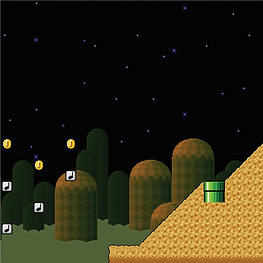


From the two elevations I was given I identified and determined which 6 elements I will use to construct my mario world. Out of the 12 elements present in my specific sections, I selected the trees, green pipes, black pipes, the ground, wooden blocks and the orange nuggets.
In terms of colour, these components correspond to a natural colour scheme, and therefore will harmonise and convey an overall terrestrial atmosphere.
TASK 2:
Concept ideas & Development

I first created a 3D model on Rhino by extruding the elements from my elevations to assist my design and visualisation of an overall balanced and engaging composition. Initially, I outlined the specific components for accuracy in regards to alignment and scale, projecting and placing them throughout my spatial field. I then duplicated these building blocks, designing the space and creating repetition throughout.
Essentially, I split my space into two sections by creating two half boxes- one for the front elevation and one for the back. My concept involved the idea of presenting predominately the earthly trees in the foreground and the lighter floating forms towards the back. This concept is reinforced with the horizontal and vertical pipes which not only act as the foundation of my composition, but also aid in directing eye movement upwards, demonstrating a notion of ascension with gradient transition from dark horizontal pipes to bright green vertical ones. Additionally, the two ground sections compact and unite all the separate elements together within the restrictive space, and also help establish some simplicity with its larger scale in the structural composition. The orange nuggets have the lightest and brightest colour scheme and are purposefully aligned centrally within my world to draw attention as the focal point.
I believe I successfully achieved my idea of a balanced composition through the structural arrangement of components. Organising my elements to fortify the borders of this spatial field, I established a hollow center within this ‘hidden space’ which is now opened up to view. This negative space not only ensures the content does not become too overloaded, especially since most elements are fairly small-sized and detailed, but also helps draw attention to the groups of elements itself. The openness helps separate the dark earthly features from the elements floating above, which catch more light and are brighter in colour.
TASK 3:
Axonometric hand drawing


With a completed composition plan on Rhino, I moved on to hand drawing my mario world at an orthogonal projection. I decided to split my world into half(two boxes of 100x200x200mm) and combine the two tracing paper drawings at the end. Ensuring accuracy in scale and form as I transfer the building blocks from the 2D print outs to a 3D axonometric view, I relied on my orthogonal set square and T-square, and draw plenty construction lines. Eventually, I cleaned up and outlined my final work for scanning and tracing digitally.
TASK 4:
Colour Palette and Adobe Illustrator work


I first used the pen tool to accurately trace my drawing.
With considerations of colour at the initial stage of designing my mario world composition, I ensured each element and its details was correspondent to its original colour palette. I paid great attention to the textures of each element as I believe the small details are pivotal characteristics of world 3.
Final details and adjustments:
Light & Shadow- With consideration of the night sky as background, I idealised my light source to be from the front left, hence casting the shadows accordingly. I also slightly adjusted the colour of all shadows to complement the colour of the element the shadow is casted on; shadows on the wood blocks possess a brown tone, while shadows casted on trees and green pipes are more green toned.
REFLECTION
As this module focused on the transition between 2D and 3D, I now have a greater understanding of pictorial space and aspects of perspective and projection in relation to a geometrical representation.
Moreover, I was able to improve my technical drawing skills, both by hand and digitally.
This project allowed me to experiment and be innovative with acknowledgement of restrictions, as my mario world consisted of original formations in addition to existing arrangements. The ability to project the flatness of the Mario world into a dimensional and structural composition feels so compelling, since so much more detail which were originally hidden in the same world can now be perceived.
I believe my decision to focus on space, colour and texture, which considers both the big picture and the details, is predominate in the presentation of my mario world. I feel proud of my final composition design, which I would describe to appear balanced and modest.